
UITM Rzeszow Presents Integrated Lecture Series on Overconsumption, ChatGPT, Planetary Awareness and Climate Change
Introduction to the Series
On 10 March 2025, the University of Information Technology and Management (UITM) in Rzeszów opened a new academic window into the interlinked challenges of overconsumption, artificial intelligence, planetary consciousness and climate change. The series is designed for scholars, students and professionals who seek a grounded understanding of how systems thinking, technology and cultural perspectives shape contemporary environmental debates.
Conference Outline and Key Dates
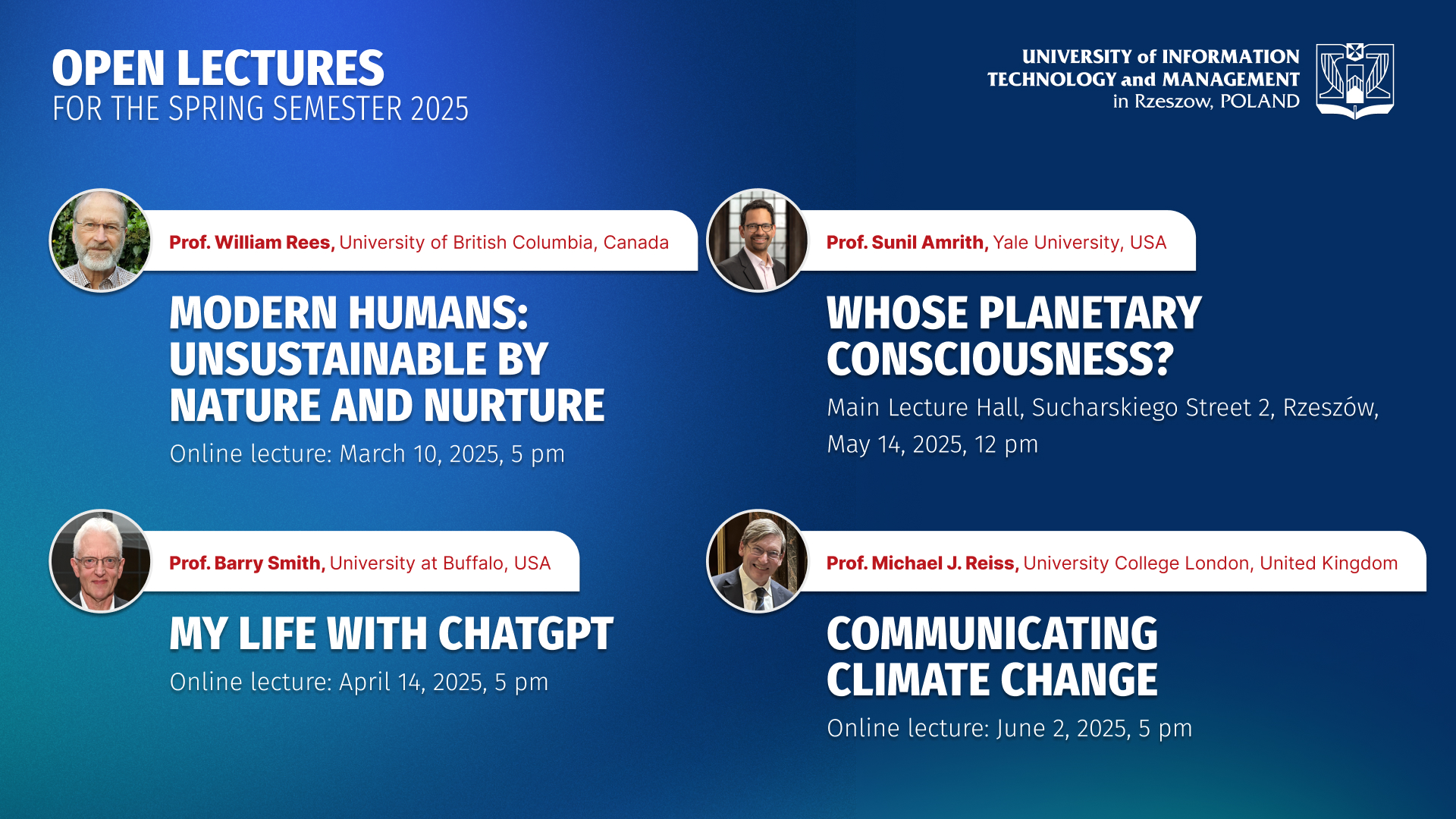
The six‑lecture lineup runs between 10 March and 2 June 2025. Sessions are delivered online or on campus, providing flexibility for international attendees. The schedule is as follows:
- 10 March – *Modern Humans: Unsustainable by Nature and Nurture* – Prof. William Rees, University of British Columbia
- 14 April – *My Life with ChatGPT* – Prof. Barry Smith, University at Buffalo
- 14 May – *Whose Planetary Consciousness?* – Prof. Sunil Amrith, Yale University
- 2 June – *Communicating Climate Change* – Prof. Michael J. Reiss, University College London
Additional talks will take place in April at the UITM auditorium on the campus of the School of Information Technology, ensuring local students can attend in person.
Speaker Profiles and Content Highlights
Prof. William Rees – Overconsumption Analysis
Prof. Rees brings a decade of work on ecological economics and the ecological footprint methodology. His lecture will assess global consumption patterns and the mismatch between human demand and planetary boundaries, pointing to policy levers that could slow the rate of resource depletion.
Prof. Barry Smith – The Role of ChatGPT and Language Models
With expertise in ontology and data science, Prof. Smith interrogates the hype surrounding large language models (LLMs). He will explore ethical considerations, the potential for misuse, and how LLMs might support climate science through data synthesis and model development.
Prof. Sunil Amrith – Planetary Consciousness in Historical Context
Drawing on post‑colonial theory and the history of environmental thought, Prof. Amrith will trace the evolution of planetary ethics. His talk will challenge the reader to evaluate whether contemporary environmental advocacy still reflects imperialist assumptions and to propose pathways for more inclusive stewardship.
Prof. Michael J. Reiss – Climate Communication Strategies
Prof. Reiss, an authority on science education, will dissect the challenges of conveying climate science amid politicisation. The lecture will illustrate effective pedagogic models and communication tactics that respect diverse cultural lenses while maintaining scientific rigor.
Intersections of Overconsumption, AI and Climate Change
Each speaker emphasises how the three core concerns shape one another. For instance, AI tools can accelerate environmental monitoring but also contribute to energy consumption. Overconsumption fuels climate change, which in turn demands new governance models—an emerging discourse explored throughout the series.
Why This Series Matters to Universities and Professionals
Academic institutions sit at the centre of research, education and policy dialogue. By attending or hosting these lectures, universities demonstrate commitment to interdisciplinary learning and produce graduates equipped to tackle complex sustainability issues.
- Students gain exposure to leading scholars and contemporary challenges.
- Faculty can weave these themes into curricula and research projects.
- Industry partners discover cutting‑edge approaches to responsible AI and low‑carbon operations.
Engaging with the Series – How to Participate
Registration is free for students and faculty, while corporate guests may request a sponsorship package. Interested parties should visit the UITM lecture series page and complete the online form before 31 March. Attendance can be live via Zoom or recorded for later viewing. Technical details will be sent upon registration.
Anticipated Outcomes for Attendees
Networking Opportunities
The series will attract a diverse cohort, offering networking spots with peers, advisors and potential employers.
Applied Knowledge Transfers
Participants will leave with actionable insights—such as how to design carbon‑aware projects or interpret AI outputs responsibly—ready to apply in their respective professions.
Research Collaboration Seeds
Many topics align with emerging research grants (e.g., EU Horizon Europe, Canada’s Sustainable Development initiatives). The lectures encourage collaboration proposals that could secure funding for interdisciplinary projects.
Conclusion and Next Steps
The UITM lecture series offers a timely convergence of environmental science, technology ethics and societal narratives. Embracing these discussions positions the university and its community to shape the trajectory of sustainable development responsibly.
If you are a student, researcher or professional interested in these subjects, submit your application today and join a community of forward‑thinking scholars dedicated to evidence‑based solutions.
Schedule a contact meeting with the Academic Events Office to explore how you can incorporate these topics into your studies or workplace initiatives.
Questions? Reach out through the campus inbox or schedule a consultation with the liaison for the lecture series.
Share your thoughts in the comments below and stay updated by following UITM’s social media channels.