
Salome Baslandze on AI’s Economic Impact at ISET Research Seminar
Understanding AI’s Economic Impact Through Corporate Research
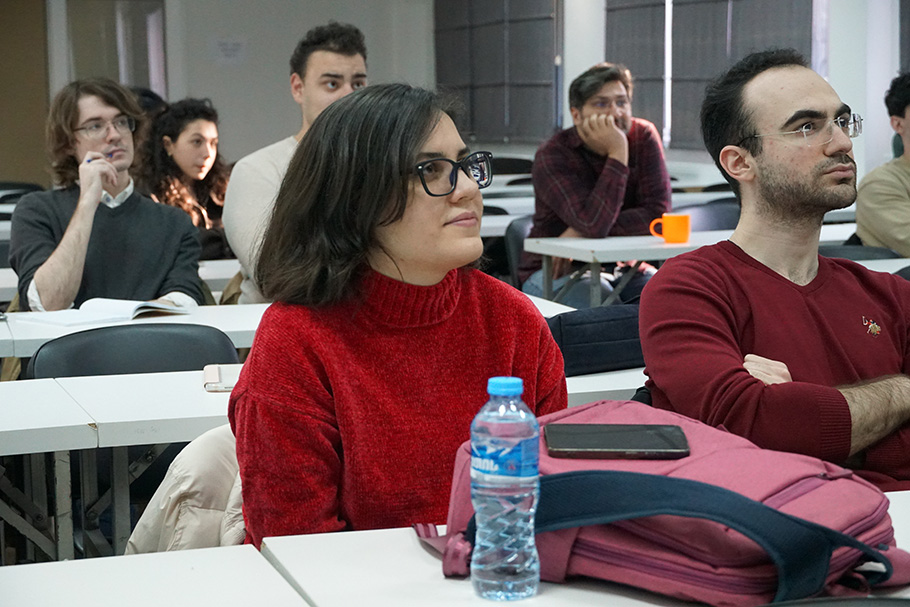
The International School of Economics at Tbilisi State University (ISET) recently hosted an insightful session featuring Salome Baslandze, a distinguished alumna and current researcher at the Federal Reserve Bank of Atlanta. Her presentation, titled “Artificial Intelligence, Productivity, and the Workforce: Evidence from Corporate Executives,” offered valuable insights into how AI is reshaping business operations and economic landscapes.
Key Findings from the Corporate AI Survey
Baslandze’s research, based on a comprehensive survey of nearly 750 corporate executives, reveals several important trends in AI adoption and its economic implications. The study demonstrates that AI implementation is already widespread across industries, though adoption rates vary significantly between organizations of different sizes.
Larger firms show stronger AI uptake compared to smaller businesses, suggesting that scale and resources play crucial roles in successful AI integration. This finding has important implications for economic development strategies and policy-making in emerging markets like Georgia.
Productivity Gains and Economic Transformation
The research documents substantial positive productivity effects, particularly in high-skill service sectors and financial industries. These gains are primarily driven by two factors: innovation enhancement and increased demand for AI-enabled products and services.
Looking ahead to 2026, the study projects that productivity benefits will continue to grow as organizations become more sophisticated in their AI implementation strategies. This forward-looking perspective is particularly relevant for ISET students and faculty considering future research directions and curriculum development.
The Productivity Paradox and Labor Market Dynamics
One of the most intriguing findings is what researchers term the “productivity paradox” – where executives’ perceived productivity gains from AI exceed what can be measured through traditional metrics. This suggests that current evaluation methods may not fully capture AI’s economic value.
Regarding employment impacts, the research finds limited evidence of immediate job losses. Instead, it indicates a gradual transformation of labor demand, characterized by declining routine task positions and increasing demand for skilled technical workers. This shift underscores the importance of education and training programs that prepare students for the evolving job market.
Implications for ISET and Economic Education
The findings from Baslandze’s research have significant implications for ISET’s academic programs and research agenda. As AI continues to transform economic landscapes, educational institutions must adapt their curricula to prepare students for these changes.
For students in ISET’s Bachelor and Master programs in Economics and Finance, understanding AI’s economic impact is becoming increasingly essential. The research highlights the need for courses that combine technical knowledge with economic analysis, preparing graduates to navigate and shape the AI-driven economy.
Future Research Directions
The study opens several avenues for future research, particularly relevant to ISET’s academic community. These include investigating the long-term effects of AI on economic inequality, exploring regional variations in AI adoption, and examining the relationship between AI implementation and economic growth in developing economies.
Additionally, the research methodology employed – surveying corporate executives – provides a model for future studies that bridge academic research with practical business applications. This approach aligns well with ISET’s mission to connect theoretical knowledge with real-world economic challenges.
Connecting Research to Practice
The ISET Research Seminar Series, which hosted this presentation, serves as an important platform for connecting cutting-edge research with academic and professional communities. Such events provide valuable opportunities for students, faculty, and industry professionals to engage with emerging economic trends and research findings.
For ISET students and alumni, understanding the economic implications of AI is crucial for career development and research opportunities. The insights from this research can inform career choices, research topics, and professional development strategies in an increasingly AI-driven economic environment.
Educational Implications and Student Opportunities
The research findings highlight the growing importance of AI literacy in economic education. ISET’s various programs, including its Bachelor and Master degrees in Economics and Finance, may need to incorporate more content related to AI and its economic implications.
Students interested in this field might consider focusing their thesis work on AI-related topics or pursuing opportunities in organizations that are at the forefront of AI implementation. The research also suggests potential career paths in AI strategy consulting, economic analysis of technology adoption, and policy development related to AI and labor markets.
Looking Forward
As AI continues to evolve and reshape economic landscapes, ongoing research and education will be crucial for understanding and adapting to these changes. ISET’s role in fostering research and education in this area positions it well to contribute to Georgia’s economic development in the AI era.
The insights from Baslandze’s research provide a foundation for understanding current trends while highlighting the need for continued investigation into AI’s long-term economic impacts. For students, faculty, and policymakers, staying informed about these developments will be essential for making informed decisions in an increasingly AI-driven world.
The presentation at ISET demonstrates the institution’s commitment to bringing relevant, cutting-edge research to its community while fostering dialogue about important economic issues. As AI continues to transform economies globally, such research and educational initiatives will play a crucial role in preparing the next generation of economic leaders and researchers.