
RIT Croatia New Media Design Students Present Points of Contact at Zagreb Design Week 2026
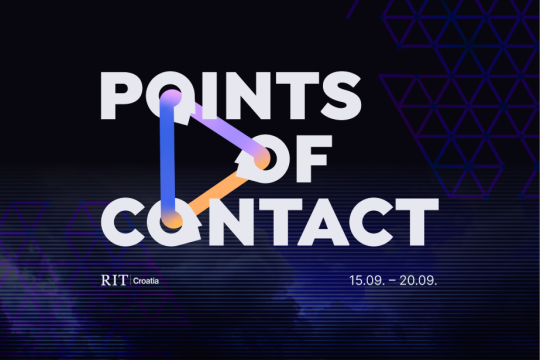
Every encounter leaves a trace. That idea anchors Points of Contact, the exhibition that RIT Croatia brings to Zagreb Design Week 2026 this September. Conceived and produced by students in the university’s New Media Design program, the installation examines how human connections form, persist, and reshape themselves over time — much like particles in physics that stay linked no matter the distance between them.
Running from September 15 to 20, 2026, at the Academy of Fine Arts in Zagreb, the exhibition is part of the official Zagreb Design Week program. Beyond its conceptual ambition, it demonstrates something equally important: what happens when design students receive serious mentorship, real production deadlines, and a public platform for their work.
Whether you are a prospective student weighing design programs, a creative professional tracking Croatia’s design scene, or simply a visitor looking for a memorable experience during Design Week, here is what to know before you go.
Curious about the program behind the project? Explore the New Media Design BFA at RIT Croatia to see how classroom learning connects to real public exhibitions.
The Concept Behind Points of Contact: When Physics Meets Human Connection
The intellectual starting point for the exhibition is quantum entanglement — the phenomenon in which two particles remain connected across any distance, so that a change to one is reflected in the other. The students behind Points of Contact borrow this idea as a metaphor for human relationships.
Under this framing, a connection between two people is never static. It evolves through memory, reinterpretation, and shared influence. A conversation from years ago continues to shape how we respond to someone today. A mentor’s comment resurfaces in a design choice made a decade later. Even brief encounters — the kind that seem insignificant at the time — can leave marks that influence our creative and personal trajectories.
Translating an abstract scientific concept into a spatial, interactive experience is a demanding brief. It requires students to move beyond purely visual thinking and consider how visitors move through an environment, what they touch, what they remember, and how those impressions shift on a second visit. That challenge is precisely the point: projects like this train designers to think in systems rather than screens, a skill that separates professionals from hobbyists.
Inside the Exhibition Space at the Academy of Fine Arts
Points of Contact runs from September 15 to 20, 2026, hosted at the Academy of Fine Arts in Zagreb as part of the official Zagreb Design Week program. The venue itself carries weight: presenting student work in an institution dedicated to fine art places the project in dialogue with a broader artistic tradition and raises expectations for craft and execution.
According to its creators, the space comes to life through a dialogue between structure and experimentation. Visitors can expect an environment designed to be explored rather than merely observed — one that invites them to consider how connections can be formed and remembered.
A practical detail worth noting: throughout the event, the New Media Design students who built the exhibition will be present in the space. They will walk visitors through the environment, explain the decisions behind it, and answer questions. For anyone considering a career in design, speaking directly with students about their process is one of the most valuable things a design festival offers — it is honest, unfiltered information about what studying design actually involves.
Faculty Mentorship: The Engine Behind Student Achievement
Student success at this scale rarely happens without structured guidance. The Points of Contact exhibition was developed under the mentorship of four RIT Croatia faculty members:
- Marija Kamber
- Dr. Mia Klemenčić
- Dr. Jurica Dolić
- Dr. Petar Branislav Jelušić
This model — experienced faculty guiding students through a real, publicly presented project — reflects a broader principle in design education: the fastest way to learn is to produce work for a real audience under real constraints. Classroom exercises have value, but a live exhibition adds stakes that sharpen every decision, from concept development to installation logistics.
For students, mentorship of this kind does two things. First, it compresses years of trial and error into a single project cycle, because experienced faculty can flag problems before they become costly. Second, it teaches students how to defend and articulate their creative choices — a skill that matters just as much in job interviews and client meetings as technical proficiency does.
Seven RIT Croatia Finalists Compete for the ZGDW Award
The group exhibition is only part of the story. Seven individual New Media Design students have also been named finalists for the ZGDW Award, competing across three categories: Graphic Design, Product Design, and Digital Communication and Interaction Design.
The finalists and their projects are:
- Leon Krile — Deck and Lekri
- Ida Mihaica — Be-For-Sex
- Nora Miškulin — Orchidea
- Nutsa Sesiashvili — Folded Forest
- Asita Singh — Bareform and Campfire Tales
- Đivo Vidak — Relaxo
- Magdalena Žulj — Virtual Pet Project: Hide and Seek
The range of projects — from product concepts to digital and interactive work — illustrates the breadth of the New Media Design discipline itself. Contemporary designers rarely work in a single medium. A single career can span brand identities, physical products, interfaces, and interactive experiences, often within the same year.
The award ceremony takes place on September 15, when the winners across all categories will be announced. Attending the opening day therefore offers a double payoff: the launch of the Points of Contact exhibition and the public recognition of Croatia’s emerging design talent.
Why Zagreb Design Week Participation Matters for Emerging Designers
For students, involvement in a major design event delivers benefits that a classroom cannot replicate. Prospective students evaluating programs should pay close attention to this kind of activity, because it signals how a program prepares graduates for professional life.
Portfolio Work With Public Accountability
Design hiring decisions rest overwhelmingly on portfolios. A project that has been exhibited publicly, reviewed by strangers, and presented in person carries more weight than coursework shown only in a classroom. Finalist nominations and award shortlists add third-party validation that employers and graduate programs recognize immediately.
Networking in a Professional Setting
Design weeks concentrate agencies, studios, press, and educators in one place over a few days. For students approaching graduation, these are the rooms where first conversations with future employers happen — often casually, in front of an exhibition piece the student can explain with authority because they built it.
Feedback From Diverse Audiences
A visitor to a public exhibition does not owe the designer politeness. They react honestly: they linger, they skip, they misunderstand, or they engage. Learning to read those reactions — and to iterate based on them — is a core professional skill that develops fastest under real conditions.
Positioning Zagreb as a Regional Design Hub
Zagreb Design Week has grown into a significant regional platform, drawing designers and visitors from across Central and Southeastern Europe. For a program like RIT Croatia’s, exhibiting there signals that its students operate at a standard relevant beyond the campus — and that Croatia’s creative economy has strong local pipelines of trained talent.
Studying New Media Design at RIT Croatia
The exhibition offers a window into what the New Media Design BFA at RIT Croatia actually teaches. The program sits at the intersection of design, technology, and communication, preparing students to create for digital and physical environments alike — websites, applications, interactive installations, motion graphics, and brand systems.
Several features of the program stand out, and the Zagreb Design Week participation reflects them directly:
- Project-based learning. Students build real deliverables for external audiences rather than completing only isolated assignments.
- Faculty with active academic and professional practice. The mentors behind Points of Contact bring both research depth and applied experience to studio work.
- An American degree earned in Europe. RIT Croatia is part of the Rochester Institute of Technology, offering programs on campuses in Zagreb and Dubrovnik with instruction in English.
- Career-focused education. The university emphasizes experiential learning, including cooperative education and engagement with industry partners.
If you want to evaluate the program firsthand, schedule a visit to RIT Croatia’s Zagreb campus and see the studios and student work in person.
For international students considering study in Croatia, the combination of an American curriculum, a European cultural environment, and a growing tech and creative sector makes a practical case. Zagreb’s cost of living remains moderate by European standards, and the city’s design and startup communities provide natural entry points for internships and first jobs after graduation.
Plan Your Visit: Dates, Location, and Program Details
If you plan to attend Points of Contact, keep these details in mind:
- What: Points of Contact, an exhibition by New Media Design students at RIT Croatia
- Where: Academy of Fine Arts, Zagreb
- When: September 15–20, 2026, as part of the official Zagreb Design Week program
- Award ceremony: September 15, 2026, when ZGDW Award winners will be announced
- What to expect: An interactive environment exploring human connection, with the student creators present to guide visitors through the work
Arriving on opening day gives you the fullest experience: the exhibition launch, the student presentations, and the award ceremony all take place on the same date. If you can only attend once, September 15 is the day to choose.
Have questions about studying New Media Design in Croatia? Contact the RIT Croatia admissions team for answers tailored to your background and goals.
Take the Next Step Toward a Design Career
Points of Contact is more than a Design Week attraction. It is evidence of what structured mentorship, a project-based curriculum, and student ambition can produce — and a preview of the kind of work future students will create. If the exhibition sparks your interest in design as a career, several practical steps can turn that interest into a plan.
- Attend the exhibition. See the work firsthand and speak with the students who built it.
- Research the New Media Design BFA to understand the curriculum, admission requirements, and career outcomes.
- Become a Student for a Day or arrange a campus visit at RIT Croatia to experience the learning environment directly.
- Submit your application when you are ready — every strong portfolio and design career starts with a first project.
Design careers are built on points of contact: between ideas and execution, between mentors and students, between creators and the audiences who experience their work. This September in Zagreb, RIT Croatia’s New Media Design students will show exactly what those connections can produce. Visit the exhibition, meet the designers, and see where your own point of contact with design might begin.