Analyzing Exposure to Violence and Prosocial Attitudes at the International School of Economics ISET
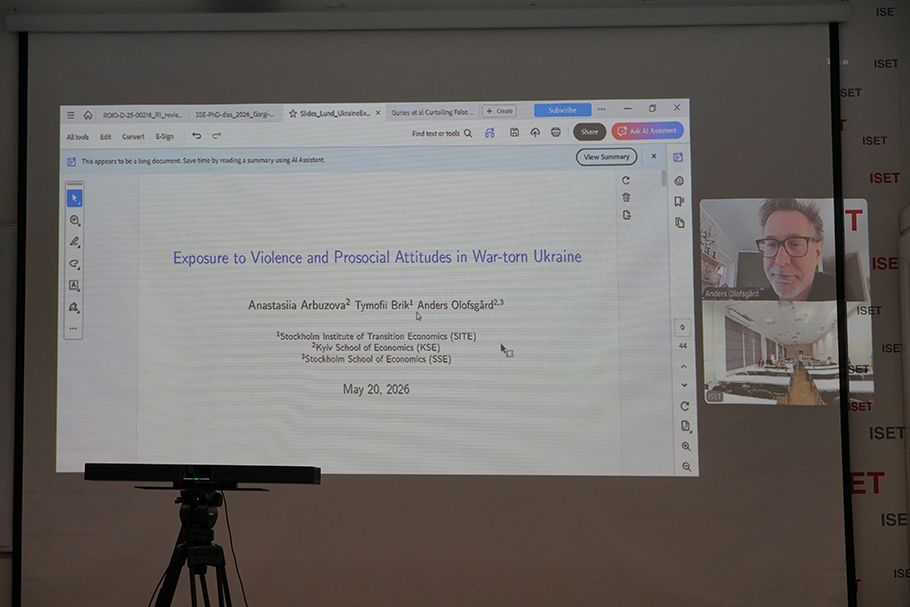
Examining the socio-economic consequences of armed conflict requires rigorous empirical research and a deep understanding of human behavior under extreme stress. Recently, the International School of Economics ISET in Georgia hosted a critical academic discussion on this very topic. The institution welcomed Professor Anders Olofsgård, an Associate Professor at the Stockholm School of Economics and Deputy Director of the Stockholm Institute of Transition Economics, to present his latest findings. His presentation, titled “Exposure to Violence and Prosocial Attitudes in War-torn Ukraine,” provided valuable insights into how living through war fundamentally alters social fabric, community trust, and political attitudes.
Understanding the Socio-Economic Impact of Conflict in Eastern Europe
The economic study of conflict has traditionally focused on quantifiable metrics: infrastructure destruction, gross domestic product (GDP) contraction, and population displacement. However, a growing body of research highlights that the most enduring impacts of war are often invisible, manifesting as changes in social capital and human psychology. When communities experience prolonged exposure to violence, the foundational elements of a functioning economy—trust, cooperation, and institutional reliance—are severely tested.
For nations in Eastern Europe and the post-Soviet space, understanding these dynamics is particularly urgent. Georgia, sharing a border with Russia and having experienced its own territorial conflicts, serves as a highly relevant academic hub for this discourse. The International School of Economics ISET provides a neutral, rigorous platform where regional and international scholars can convene to analyze these pressing geopolitical and economic issues. By hosting leading experts like Professor Olofsgård, ISET ensures that local students and policymakers have access to the most current empirical methodologies used to assess conflict-driven societal shifts.
Schedule a free consultation to learn more about ISET’s economics programs.
Key Findings from the ISET Research Seminar on Ukraine
Professor Olofsgård’s research investigates a central, highly debated question in conflict economics: does exposure to violence increase cooperation and social engagement, or does it destroy trust and fracture communities? The empirical findings presented during the seminar revealed a complex, highly nuanced reality that defies simple categorization.
The Paradox of In-Group Cooperation vs. Out-Group Distrust
The data indicates that conflict exposure tends to increase cooperation and political participation, but with a strict limiting factor: this increased prosocial behavior is largely confined to tightly defined in-groups. When individuals face existential threats, they naturally gravitate toward their immediate community, neighbors, and local networks for mutual aid and survival. This phenomenon results in heightened local civic engagement and a stronger sense of shared purpose within the affected community.
Conversely, the research demonstrated that trust toward outsiders—including foreign allies and international institutions—can actually decline. This out-group distrust presents a significant challenge for international relations and foreign policy. As communities turn inward to survive, skepticism of external actors often grows, creating a paradoxical situation where a population becomes more internally cohesive but more externally isolated.
Implications for EU Accession and Western Alliances
During the ISET Research Seminar, Professor Olofsgård applied these findings directly to the current geopolitical situation in Ukraine. The implications are profound. At a time when the United States and European commitments are being closely scrutinized, understanding how daily exposure to violence shapes public support for EU accession is critical for European policymakers.
If violence hardens in-group identities and fosters skepticism of outsiders, how does this impact the Ukrainian public’s enthusiasm for integrating with Western institutions? The research suggests that policymakers cannot assume that shared adversity automatically translates into unwavering support for international alliances. Instead, external supporters must actively work to maintain trust and demonstrate reliability, recognizing that the psychological toll of conflict can erode the very social trust required for long-term geopolitical integration.
Methodological Approaches to Measuring Prosocial Attitudes
A significant portion of the discussion at the International School of Economics ISET focused on the methodology behind these conclusions. Measuring prosocial attitudes and trust in an active conflict zone is notoriously difficult. Traditional survey methods are often compromised by security concerns, displacement, and the psychological state of respondents.
To overcome these hurdles, researchers must employ advanced econometric techniques and carefully designed survey instruments. Professor Olofsgård’s work relies on distinguishing between different types of violence exposure—whether individuals experienced violence directly, witnessed it, or knew someone who was affected. By isolating these variables, researchers can more accurately determine the causal relationship between conflict exposure and changes in social behavior. This level of methodological rigor is a cornerstone of the academic training provided at ISET, where students learn to look beyond surface-level data to uncover underlying economic truths.
Submit your application today to join the next cohort of economic researchers.
Why the International School of Economics ISET Leads Regional Research
The hosting of this seminar is a clear reflection of the International School of Economics ISET’s broader mission in Georgia and the South Caucasus. Since its founding, ISET has positioned itself as the premier institution for economic education and policy research in the region. The faculty comprises experienced local and international academics who bring real-world policy analysis into the classroom.
The ISET Research Seminar series is a vital component of this ecosystem. By regularly inviting scholars from top-tier international institutions—such as the Stockholm School of Economics, Bielefeld University, and the Federal Reserve Bank of Atlanta—ISET bridges the gap between global academic research and regional economic challenges. For students, these seminars offer a unique opportunity to engage with cutting-edge research, question established methodologies, and understand how theoretical economics applies to acute real-world crises like the war in Ukraine.
Furthermore, ISET’s focus on transition economics makes it uniquely qualified to host discussions on conflict and social capital. Transition economies are inherently volatile, and adding the variable of armed conflict creates complex economic environments that require specialized analytical tools. The curriculum at ISET is specifically designed to equip graduates with these tools, preparing them for careers in policy-making, international development, and advanced academic research.
Explore our related articles for further reading on conflict economics and transition societies.
Applying Conflict Economics Research to Policy and Development
The insights shared during the seminar extend far beyond academic interest; they have direct, actionable implications for international development organizations and local governments. If exposure to violence fractures trust in outside institutions, then post-conflict reconstruction strategies must prioritize community-led initiatives. Top-down approaches imposed by international actors may fail if the underlying social trust required to implement them has been damaged by conflict.
Policymakers must recognize that rebuilding an economy after war is not solely a matter of injecting capital or repairing physical infrastructure. It requires a deliberate, targeted effort to rebuild social capital. This includes supporting local civil society organizations, facilitating community dialogue, and creating economic opportunities that encourage positive interactions between different social groups. The research presented by Professor Olofsgård provides an empirical foundation for these strategies, proving that social dynamics must be measured and addressed with the same rigor as traditional economic indicators.
Engage with Advanced Economic Research in Georgia
The discussion surrounding exposure to violence and prosocial attitudes highlights the critical need for high-quality economic research in understanding modern conflicts. As the situation in Eastern Europe continues to evolve, the demand for professionals who can accurately analyze these complex socio-economic dynamics will only increase. Institutions like the International School of Economics ISET play an indispensable role in cultivating this expertise in Georgia and the wider region.
For aspiring economists, policy analysts, and researchers, engaging with this caliber of academic discourse is essential for professional development. The opportunity to analyze empirical data on conflict, question leading researchers, and apply theoretical frameworks to ongoing geopolitical events is what distinguishes a standard economics education from a transformative academic experience.
Have questions about the research seminar series or our academic programs? Write to us!