Alte University Faculty Member Leads ERASMUS+ Teaching Mobility at Pomeranian University
International academic exchange remains a fundamental driver of educational quality and institutional growth. Recently, Mariam Sharia, a guest lecturer at Alte University in Georgia, completed a dedicated working visit to the Pomeranian University in Słupsk, Poland. This initiative took place under the prestigious ERASMUS+ Staff Mobility for Teaching program, a framework designed to foster cross-border collaboration and elevate educational standards across European and partner institutions.
Expanding Academic Horizons Through ERASMUS+ Staff Mobility
The ERASMUS+ Staff Mobility for Teaching program serves a distinct and vital purpose in the landscape of higher education. Unlike student exchange programs, this initiative specifically targets faculty and administrative staff, enabling them to share their expertise, pedagogical methods, and research findings with partner institutions abroad. For the host institution, it brings fresh perspectives and specialized knowledge into the classroom. For the visiting academic, it provides an opportunity to test their curriculum in a new cultural context, receive diverse feedback, and build networks that can lead to future research collaborations.
Mariam Sharia’s participation in this program highlights the active role that Alte University plays in the European educational space. By sending faculty members to teach abroad, Alte University demonstrates a commitment to not just consuming international best practices, but actively contributing to the global academic community. Schedule a free consultation to learn more about international study opportunities.
Bridging Georgian and Polish Higher Education Institutions
The collaboration between Alte University in Georgia and the Pomeranian University in Słupsk represents a strategic alignment between two institutions that value practical, modern education. Pomeranian University has established itself as a significant regional hub in Poland, known for integrating theoretical knowledge with applied skills. Hosting a visiting lecturer from the Caucasus region allows Polish students and faculty to engage directly with the evolving educational methodologies developing in Georgia.
Conversely, this mobility allows Alte University to align its programs more closely with European standards. When faculty members like Mariam Sharia return to Georgia, they bring back insights into how European universities structure their IT and design programs, manage classroom dynamics, and integrate industry trends into their syllabi. This bidirectional flow of knowledge strengthens the foundational partnership between the two universities and sets the stage for more complex joint ventures, such as dual-degree programs or collaborative research grants.
Applying Design Thinking in IT Education
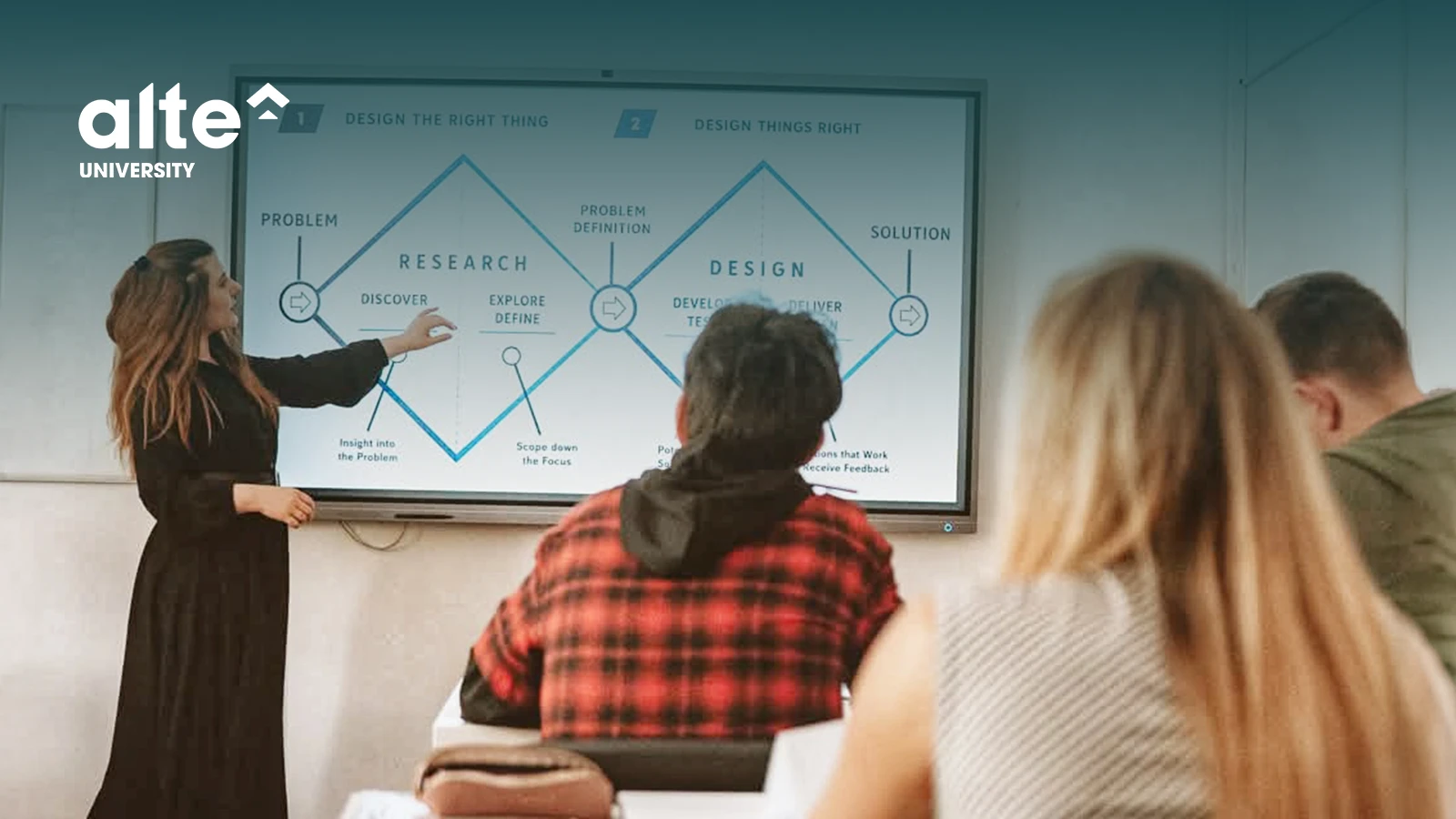
A central component of the working visit focused on the intersection of technology and user experience. Mariam Sharia conducted an intensive lecture-workshop for students and IT faculty members titled “Design Thinking: A Problem-Solving Approach in IT.” In the modern tech landscape, the ability to write code is often secondary to the ability to solve the right problem. Design thinking provides a structured framework for achieving this.
Understanding the Design Thinking Methodology
During the session at Pomeranian University, participants explored the five core stages of design thinking: empathize, define, ideate, prototype, and test. The workshop emphasized that IT solutions frequently fail not because of technical flaws, but because they do not address the actual needs of the end-user. By starting with empathy—understanding the user’s pain points, environment, and behaviors—IT professionals can define problems more accurately.
The lecture moved beyond abstract theory, requiring participants to apply these stages to hypothetical software development scenarios. Faculty members and students worked together to map out user journeys, define problem statements, and brainstorm solutions without the immediate constraint of technical feasibility. This approach encourages expansive thinking before narrowing down to a viable prototype.
Practical Applications for IT Students and Faculty
For IT students, mastering design thinking alters their career trajectory. It shifts their professional identity from mere “coders” to problem-solvers and product strategists. The workshop demonstrated how this methodology reduces the risk of building products that no one wants to use, thereby saving development time and financial resources. For the IT faculty at Pomeranian University, the session provided a pedagogical case study on how to integrate non-technical, human-centric frameworks into highly technical computer science curricula. Explore our related articles for further reading on design methodologies.
Graphic Design as a Strategic Visual Communication Tool
In addition to the IT-focused workshop, Mariam Sharia led a specialized session tailored for Graphic Design students, titled “How Graphic Design Works as a Visual Communication Tool.” This session addressed the foundational principle that graphic design is not merely about aesthetics; it is a functional discipline rooted in communication psychology.
The Psychology of Shapes and Colors
A significant portion of the session was dedicated to the tactical use of visual elements—specifically shapes and colors—to evoke specific emotions and convey distinct messages. Participants analyzed how geometric shapes (circles, squares, triangles) communicate different attributes. For example, circles often imply community and softness, while squares suggest stability and reliability, and triangles denote energy or tension.
The lecture also delved into color theory, examining how cultural contexts can shift the meaning of a color, while certain biological responses remain universal. Students learned how to construct color palettes that guide the viewer’s eye, establish brand identity, and create visual hierarchy. Understanding these mechanics allows designers to make intentional choices rather than relying on subjective preference.
Interactive Learning Through Case Studies
Rather than passively absorbing information, students engaged in interactive activities that required them to deconstruct existing branding campaigns and redesign them based on different emotional objectives. By working through practical case studies, participants learned how to manipulate visual variables to change the narrative of a design piece. This hands-on approach ensures that theoretical knowledge translates directly into portfolio-worthy skills, better preparing the students for the demands of the modern design industry.
Cultivating Global Academic Partnerships at Alte University
Mariam Sharia’s working visit to Poland is a direct reflection of the broader internationalization strategy at Alte University. Building a globally competitive university requires more than just updating local facilities; it requires embedding the institution within a network of international partners. Alte University continuously strives to create these international opportunities for its staff, recognizing that faculty mobility is a highly effective mechanism for institutional capacity building.
When educators step outside their home institutions, they are exposed to different administrative processes, grading systems, and student engagement strategies. They observe how colleagues in other countries handle common academic challenges. Upon returning to Alte University in Georgia, these educators become catalysts for change, advocating for curriculum updates, introducing new teaching tools, and encouraging their local students to consider international exchange opportunities for themselves. Submit your application today to join a globally connected academic community.
The Long-Term Value of International Faculty Exchange
The benefits of the ERASMUS+ Staff Mobility program extend far beyond the duration of the actual visit. The lectures delivered by Mariam Sharia at Pomeranian University planted seeds for ongoing intellectual exchange. Students who participated in the design thinking and visual communication workshops now have a connection to a Georgian academic perspective, broadening their understanding of global educational and professional standards.
Furthermore, these mobility exercises strengthen the formal agreements between universities. Successful teaching visits build trust. When faculty members deliver high-quality, engaging content, it signals to the host institution that the partner university maintains rigorous academic standards. This trust makes it easier to negotiate student exchange agreements, joint research publications, and shared grant applications in the future.
For the higher education sector in Georgia, active participation in programs like ERASMUS+ is a critical step toward full European integration. It demonstrates that Georgian academic institutions are not isolated, but are active contributors to the European Higher Education Area. The work of faculty members like Mariam Sharia showcases the quality of instruction available at Alte University and positions the institution as a valuable partner for universities across Europe.
International collaboration in higher education requires deliberate effort and institutional support. By facilitating these exchanges, universities ensure their academic offerings remain relevant, rigorous, and aligned with global industry needs. Have questions? Write to us!