
WSPA Addresses Artificial Intelligence and Sustainability in Higher Education in Poland
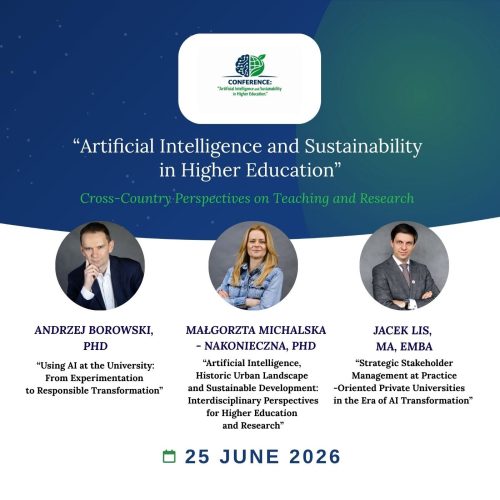
As digital technologies rapidly evolve, academic institutions face the complex task of integrating new tools while maintaining ethical standards and promoting sustainable development. The University College of Enterprise and Administration (WSPA) in Poland is actively participating in this global dialogue. By engaging in international discussions on artificial intelligence and sustainability, WSPA demonstrates a clear commitment to modernizing education and preparing students for a complex professional landscape. Submit your application today to join a progressive academic community that prioritizes these critical future-focused initiatives.
The Growing Convergence of Technology and Sustainable Academia
The intersection of artificial intelligence and sustainability represents one of the most significant current debates in the global education sector. Historically, these two fields operated in separate silos. Sustainability in higher education typically focused on campus environmental policies, green architecture, and integrating ecological literacy into the curriculum. Conversely, artificial intelligence was largely confined to computer science departments, viewed through the lens of algorithmic development, machine learning, and data processing.
Today, these domains are inextricably linked. Artificial intelligence requires substantial computational resources, which in turn demands energy consumption, prompting serious questions about the carbon footprint of digital infrastructure. Conversely, AI offers powerful mechanisms for advancing sustainability goals. Predictive analytics can optimize campus energy use, natural language processing can analyze vast amounts of climate research, and machine learning algorithms can model sustainable urban planning scenarios.
For universities in Poland and across Europe, addressing this convergence is no longer optional. Accreditation bodies, prospective students, and industry employers increasingly expect academic institutions to exhibit strong policies on both digital innovation and environmental responsibility. Institutions that fail to integrate these concepts risk falling behind in both educational quality and operational efficiency.
How WSPA in Poland is Navigating Academic Evolution
WSPA has established itself as a practice-oriented private university that responds directly to shifts in the labor market. Located in Lublin, Poland, the university has consistently focused on bridging the gap between theoretical knowledge and practical application. This approach is highly evident in how WSPA approaches the integration of artificial intelligence into its administrative and academic frameworks.
Rather than adopting AI tools simply for the sake of technological novelty, WSPA emphasizes responsible implementation. This means evaluating how algorithmic tools affect data privacy, assessing the ethical implications of automated grading or administrative processing, and ensuring that staff and faculty receive adequate training. The university recognizes that technology must serve the educational mission, not dictate it.
Furthermore, WSPA’s participation in international conferences highlights its strategy of looking beyond national borders to benchmark its practices against global standards. By collaborating with experts from Canada, Romania, the Czech Republic, and Spain, WSPA ensures that its policies regarding education in Poland are informed by a diverse array of international perspectives and best practices. Schedule a free consultation to learn more about how WSPA structures its forward-thinking academic programs.
Key Themes from WSPA’s Academic Presentations
During the international conference “Artificial Intelligence and Sustainability in Higher Education,” WSPA’s delegation focused on several distinct but interconnected areas. These presentations provide a clear window into how the university’s leadership is thinking about the future of higher education.
Moving from AI Experimentation to Responsible Integration
One of the primary challenges universities face is the transition from the experimental phase of AI to its systemic, responsible integration. Many institutions have pilot programs testing AI for tutoring, administrative automation, or research assistance. However, scaling these initiatives requires robust governance frameworks. This involves establishing clear guidelines on data security, determining accountability when AI systems make errors, and addressing biases inherent in training data.
Responsible integration also requires a cultural shift within the institution. Faculty members must be supported as they adapt their teaching methodologies to account for AI-generated content, while students need clear guidelines on academic integrity in an era where generative AI is ubiquitous. The discussion led by WSPA’s Dean of Finance and Accounting emphasized that financial and administrative leadership must work hand-in-hand with academic leadership to fund and structure these transitions effectively.
Preserving Heritage with Technology: Urban Landscapes and AI
A particularly compelling intersection of artificial intelligence and sustainability lies in the field of architecture and urban planning. Historic cities, such as Lublin, face the ongoing challenge of modernizing their infrastructure and improving energy efficiency without compromising their cultural heritage. AI provides new methodologies for tackling this problem.
Through advanced data modeling, AI can simulate the environmental impact of proposed renovations on historic buildings. It can analyze traffic patterns to reduce emissions in historic city centers and optimize the integration of modern, sustainable energy systems into older architectural frameworks. By framing this within an interdisciplinary educational context, WSPA illustrates how students in architecture and management can benefit from a curriculum that merges technical AI skills with a deep understanding of sustainable development and historic preservation.
Managing Institutional Stakeholders During Technological Shifts
Implementing artificial intelligence at a university is not merely an IT project; it is a comprehensive institutional change that affects every stakeholder group. Students expect personalized learning experiences and modern, tech-enabled campus services. Faculty require tools that reduce administrative burdens without threatening academic freedom or intellectual property. Employers demand graduates who possess AI literacy alongside traditional soft skills. Finally, administrators must balance the high costs of technological infrastructure with the need to keep tuition affordable.
Effective stakeholder management in this environment requires transparent communication and inclusive policy development. University leadership must actively involve faculty senates, student councils, and industry advisory boards in the decision-making process. The focus on practice-oriented private universities is particularly relevant here, as these institutions often have closer ties to local industries and must be highly responsive to employer needs when designing curricula that include AI competencies.
The Value of International Academic Collaboration
The decision to participate in a multinational conference with representatives from multiple European countries and Canada underscores a vital aspect of modern higher education: the necessity of international collaboration. Educational challenges related to artificial intelligence and sustainability do not respect national borders. A data privacy regulation enacted in one jurisdiction often impacts cloud-based educational tools used globally. Climate change initiatives on campus require shared research and standardized metrics.
When academic leaders from different countries share their experiences, they expose the structural differences in how higher education is funded, regulated, and delivered. For example, the approach to AI integration in a Canadian university might differ significantly from methods used in Poland due to differences in public funding models or European Union regulatory frameworks like the AI Act. Understanding these differences allows institutions to avoid common pitfalls and adapt successful strategies to their local contexts. Explore our related articles for further reading on how global trends impact local education systems.
Evaluating Universities for Future-Focused Education
For prospective students evaluating their options for higher education, the way a university handles artificial intelligence and sustainability serves as a strong indicator of its overall quality and forward-thinking approach. There are several concrete factors students and parents should consider during the application process.
First, examine the curriculum. Does the university offer dedicated courses on AI ethics, data literacy, or sustainable business practices, regardless of the student’s major? A modern education should embed these concepts across disciplines, from nursing to management to architecture. Second, investigate the institution’s campus operations. Are there visible commitments to reducing carbon emissions, managing waste, or utilizing smart building technologies? Third, look at the faculty. Are professors actively researching and publishing on these topics, or is the institution relying solely on outdated textbooks?
WSPA’s active participation in high-level international discussions indicates that its leadership and faculty are engaged with these issues at the highest levels. Students who choose to study in Poland at an institution like WSPA benefit from an environment where the administration is actively wrestling with how to deliver a relevant, ethical, and sustainable education.
Preparing for a Changing Professional Landscape
The ultimate goal of integrating artificial intelligence and sustainability into higher education is to prepare students for the realities of the modern workforce. Employers are no longer looking for candidates who only possess static knowledge; they need professionals who can adapt to new tools, think critically about the societal impacts of technology, and lead initiatives that balance economic objectives with environmental constraints.
Graduates who understand how to leverage AI for data-driven decision-making, while simultaneously advocating for sustainable business practices, will find themselves at a significant competitive advantage. Whether managing a corporate supply chain, designing energy-efficient buildings, or overseeing financial systems, the ability to navigate the intersection of technology and sustainability is becoming a baseline requirement for advancement.
By fostering an academic environment that critically examines these technologies rather than passively adopting them, WSPA provides a robust educational foundation. The university’s focus on practical, enterprise-oriented administration ensures that theoretical discussions around AI and sustainability are ultimately grounded in real-world application.
Conclusion
The integration of artificial intelligence into higher education is a complex, multifaceted process that requires careful consideration of ethical, operational, and environmental factors. The University College of Enterprise and Administration (WSPA) in Poland is actively contributing to this vital discourse. By focusing on responsible implementation, interdisciplinary research in urban sustainability, and strategic stakeholder management, WSPA is demonstrating how practice-oriented institutions can lead in the modern academic era. For students seeking an education that reflects the realities of the 21st-century economy, examining how a university engages with these global challenges is essential. Share your experiences in the comments below regarding how you see artificial intelligence shaping the future of education and the workforce.