
Examine Transparency as Trade Policy: Dr. Irene Iodice’s Research at the International School of Economics ISET
Understanding the Impact of Regulatory Uncertainty on Global Markets
Analyzing the mechanics of international trade reveals that goods do not move solely based on production costs or consumer demand. A complex web of regulations governs cross-border commerce, and the uncertainty surrounding these rules often creates more friction than the rules themselves. At a recent academic gathering, the International School of Economics ISET in Georgia hosted a detailed examination of this phenomenon, highlighting how a lack of regulatory clarity functions as a hidden, non-tariff barrier to trade.
For businesses operating in global supply chains, predictability is a foundational requirement. When a manufacturer in one country attempts to export goods to another, they must navigate a maze of technical standards, safety regulations, and labeling requirements. If these compliance rules are unclear, poorly communicated, or subject to sudden changes, exporters face a distinct dilemma. They can either invest resources to prepare for multiple regulatory scenarios or delay their market entry until they receive definitive guidance. In most cases, firms choose to wait, effectively reducing the volume of international trade and limiting consumer access to foreign goods.
The Shift from Tariffs to Technical Barriers to Trade
Over the past few decades, multilateral agreements have successfully reduced traditional tariffs across many global markets. However, as tariffs have fallen, Technical Barriers to Trade (TBTs) have risen in prominence. TBTs include mandatory technical regulations, voluntary standards, and conformity assessment procedures. While these measures are often implemented for legitimate reasons—such as protecting human health or ensuring environmental safety—they can inadvertently act as trade barriers.
The World Trade Organization (WTO) recognizes this risk and requires member states to notify other countries when they introduce new or amended technical regulations. The goal of this requirement is to ensure Transparency as Trade Policy, giving trading partners adequate time to review, comment, and adapt to new rules. Despite these WTO mandates, the actual implementation and timing of these notifications vary widely, leaving a gap in global trade governance that researchers are only beginning to quantify.
Why Exporters Hesitate Without Clear Compliance Rules
From an economic standpoint, the hesitation caused by regulatory uncertainty is a rational response. Exporting requires upfront investments in product modification, testing, and certification. If an exporter does not know the exact specifications required by the destination market, investing in compliance carries a high risk of wasted capital. Furthermore, the financial penalties or shipment rejections associated with non-compliance can be severe enough to bankrupt a small or medium-sized enterprise.
Consequently, uncertainty creates a “wait-and-see” dynamic. Exporters pause their market activities, opting to preserve capital rather than risk non-compliance. This behavior results in a measurable drop in export participation, which negatively impacts both the exporting country’s economy and the importing country’s consumers, who face fewer choices and potentially higher prices.
Have questions about how non-tariff barriers affect specific industries? Write to us!
Breakdown of Dr. Irene Iodice’s International Trade Research
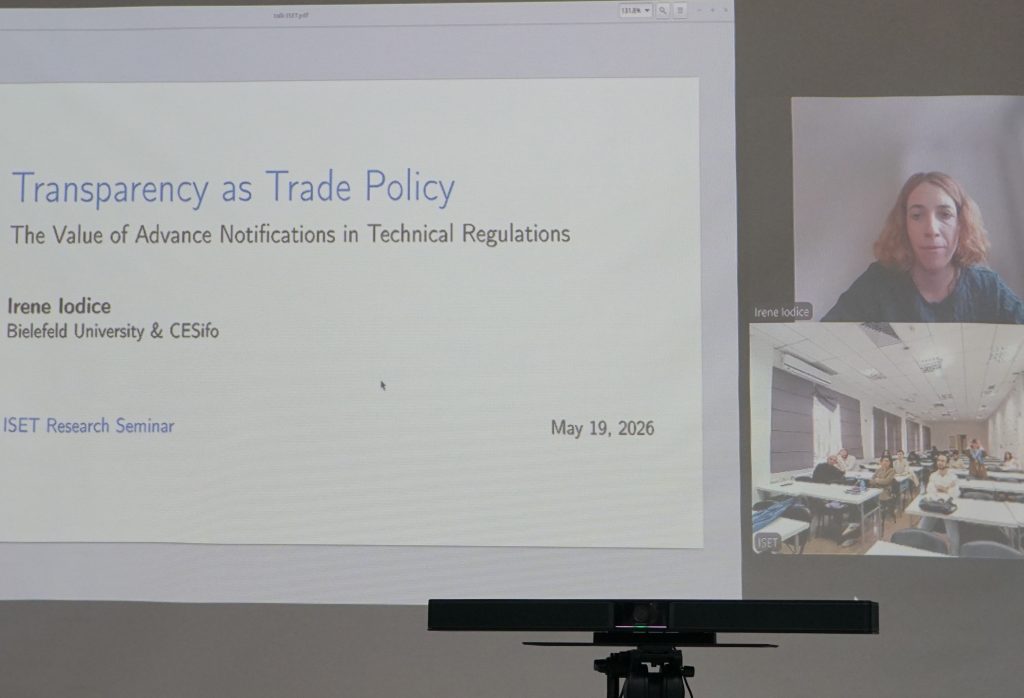
To move beyond theoretical assumptions and provide empirical evidence on this issue, the International School of Economics ISET recently hosted Dr. Irene Iodice. As an Assistant Professor of Economics at Bielefeld University and a CESifo Research Network Affiliate, Dr. Irene Iodice presented her rigorous International Trade Research titled “Transparency as Trade Policy: The Value of Advanced Notifications in Technical Regulations.” Her work provides concrete data on how regulatory opacity stifles trade and how transparency mitigates these losses.
Methodology Behind the Transparency Study
Constructing a reliable empirical model to measure the impact of regulatory uncertainty is inherently difficult due to the challenge of quantifying “what firms do not know.” Dr. Iodice overcame this by utilizing a highly detailed dataset that matched WTO TBT notifications with French export data spanning from 1995 to 2007. France serves as an excellent case study due to its diverse export base, which includes manufactured goods, agricultural products, and luxury items, all of which are subject to varying technical regulations in different destination markets.
By tracking how French export volumes reacted to the introduction of new technical regulations in destination markets, and comparing these reactions based on whether an advance WTO notification was provided, Dr. Iodice isolated the specific effect of transparency. This methodological approach allows economists to separate the cost of compliance from the cost of uncertainty, providing a clearer picture of how information flows dictate global commerce.
Quantifying the Value of Advance WTO Notifications
The findings presented at the ISET Research Seminar are striking. According to the data, the introduction of a new technical regulation in a destination market typically reduces the number of exporting firms by approximately 7 percentage points. This represents a significant contraction in market participation driven entirely by firms pausing or abandoning their export efforts due to a lack of clarity.
However, when an advance WTO notification is issued, providing exporters with prior knowledge of the regulatory changes, this participation loss is cut by more than half—dropping from 7 percentage points to just 3 percentage points. This demonstrates that a substantial portion of the trade friction caused by TBTs is not due to the difficulty of meeting the standards, but rather the lack of information about what those standards are.
Furthermore, Dr. Iodice’s research highlighted a critical “bounce back” effect. In cases where WTO notifications were delayed, French exports to the affected markets initially dropped. Yet, the moment the regulatory information was finally published, export volumes immediately recovered. This rapid rebound proves that firms were not using the delay to physically re-engineer their products; they were simply waiting for the certainty required to make informed business decisions.
Schedule a free consultation to learn more about how economic research methodologies are applied in real-world policy analysis.
Policy Implications of Transparency as Trade Policy
The conclusions drawn from this research carry substantial weight for policymakers, trade negotiators, and international organizations. By treating transparency itself as a form of trade policy, governments can achieve significant economic gains without altering a single technical standard or reducing a single tariff.
Tariff-Equivalent Value of Regulatory Clarity
One of the most compelling aspects of Dr. Irene Iodice’s presentation was the translation of transparency benefits into tariff-equivalent terms. Trade economists often use “tariff equivalents” to compare the impact of non-tariff barriers to traditional tariffs. Dr. Iodice calculated that timely WTO notification can be worth up to 28 percentage points in tariff-equivalent terms.
To put this in perspective, a 28 percentage point tariff is exceptionally high by modern standards. Achieving a trade benefit of this magnitude through traditional tariff negotiations would require years of complex, multi-lateral diplomatic efforts. Conversely, simply improving the administrative process of publishing regulatory changes in a timely manner can yield an equivalent economic benefit. This finding argues strongly for governments to invest heavily in their trade notification infrastructures and comply strictly with WTO transparency mandates.
Application to Developing Economies and Georgia
While the study utilized French export data, the implications for developing economies, including Georgia, are particularly acute. Smaller economies often lack the diplomatic leverage or financial resources to systematically monitor regulatory changes in their primary export markets. When larger trading partners introduce opaque technical regulations, firms in developing nations suffer disproportionately because they cannot easily absorb the costs of uncertainty.
For a country like Georgia, which has a Deep and Comprehensive Free Trade Area (DCFTA) agreement with the European Union, navigating technical regulations is a daily reality. Georgian exporters must continuously adapt to EU standards. Research like Dr. Iodice’s underscores the critical importance of local institutions that can track, translate, and disseminate regulatory information to domestic businesses, effectively acting as a bridge for transparency.
Explore our related articles for further reading on how trade policies impact developing economies.
The Role of the International School of Economics ISET in Georgia
The decision to host this specific research presentation highlights the broader mission of the International School of Economics ISET. Since its founding, ISET has served as a premier institution for economic education and policy analysis in the South Caucasus. By maintaining a rigorous academic environment that hosts global experts, ISET ensures that local students, faculty, and policymakers remain connected to the cutting edge of International Trade Research.
Bridging Academic Research and Real-World Policy
Events like the ISET Research Seminar series do more than simply share academic findings; they foster a culture of evidence-based policymaking. When local researchers and students engage with work like Dr. Irene Iodice’s, they gain exposure to advanced econometric techniques and novel ways of thinking about persistent economic problems. This exposure is vital for developing the next generation of policy advisors in Georgia, who will be tasked with navigating complex trade relationships and advocating for the country’s economic interests on the global stage.
The focus on Transparency as Trade Policy is especially relevant for Georgian institutions. As the country continues to integrate with European markets and seeks to diversify its export base, understanding the mechanics of non-tariff barriers becomes a practical necessity. ISET provides the intellectual framework required to analyze these challenges objectively, moving beyond political rhetoric and into the realm of quantitative assessment.
Opportunities for Aspiring Economists and Students
For aspiring economists, attending seminars led by affiliates of networks like CESifo offers invaluable professional development. It demonstrates the direct line between theoretical economics and tangible policy outcomes. Students observing this research learn that economics is not merely an exercise in mathematical modeling, but a practical tool for solving real-world logistical and informational problems in global markets.
Engaging with this caliber of research prepares students for careers in government trade ministries, international organizations like the WTO or World Bank, and private sector roles in supply chain management and international compliance. The analytical skills required to evaluate a 12-year panel dataset of export flows are highly sought after in today’s data-driven economy.
Submit your application today to join a community dedicated to rigorous economic research and policy analysis.
Conclusion: Why Trade Policy Research Matters
The presentation by Dr. Irene Iodice at the International School of Economics ISET provides a clear, data-driven lesson: in international trade, how information is shared is just as important as the regulations themselves. The finding that advance notifications can reduce export losses by over 50% and carry a tariff-equivalent value of up to 28 percentage points redefines how governments should approach trade facilitation.
As global markets become increasingly interconnected and regulatory environments grow more complex, the demand for precise, empirical International Trade Research will only increase. Institutions like ISET play a vital role in ensuring that this research is accessible, debated, and ultimately utilized to shape better economic policies. For Georgia and the broader region, embracing the principles of regulatory transparency is not just an academic exercise—it is a pragmatic strategy for economic growth and global competitiveness.
Share your experiences in the comments below regarding how regulatory changes have impacted your business or research.