
Analyze Tax Compliance Research at the International School of Economics ISET MA in Finance Program
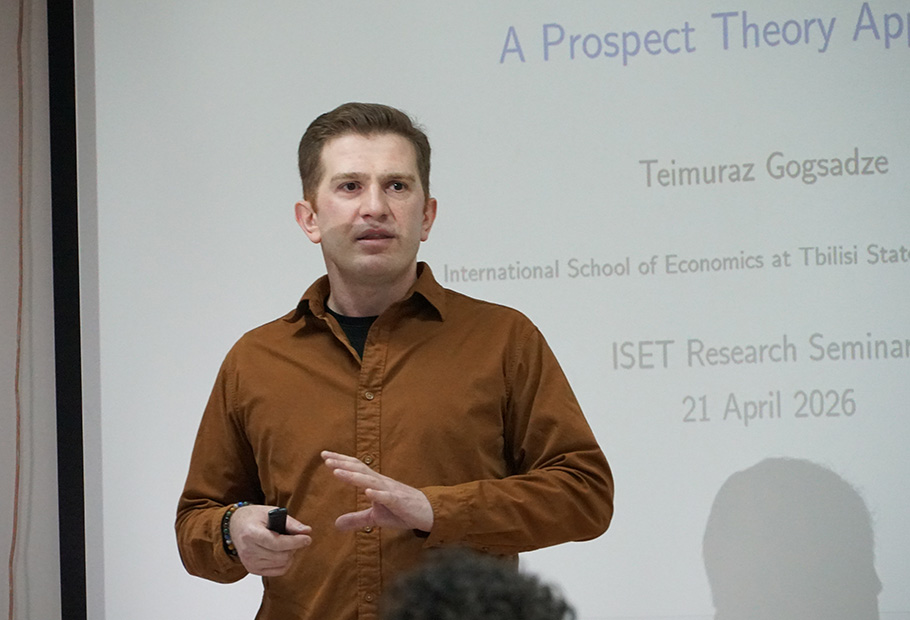
Designing effective tax policy requires a comprehensive understanding of how individuals and businesses actually behave, rather than how traditional economic models assume they behave. At a recent ISET Research Seminar, Teimuraz Gogsadze, PhD and Head of the MA Program in Finance at the International School of Economics ISET, presented a compelling framework that challenges conventional wisdom. His research, titled “Tax Compliance and Social Norms: A Prospect Theory Approach,” provides critical insights for economists, policymakers, and students interested in public finance in Georgia and beyond. By examining the intersection of behavioral economics and fiscal policy, this presentation highlighted why standard deterrence models often fall short in predicting real-world tax compliance. Schedule a free consultation to learn more about ISET’s research initiatives.
Understand the Mechanics of Tax Compliance Through Prospect Theory
For decades, the dominant framework for understanding tax evasion was the standard economic model of crime, which relies heavily on expected utility theory. In this traditional view, a rational individual calculates the probability of an audit against the financial penalty of evasion. If the expected cost of getting caught is lower than the tax owed, the model predicts the individual will cheat. However, empirical evidence consistently shows that people pay taxes at much higher rates than this simplistic model would ever predict. This discrepancy is where behavioral economics, specifically prospect theory, becomes essential for accurate analysis.
Moving Beyond Traditional Economic Models
Prospect theory, originally developed by Daniel Kahneman and Amos Tversky, demonstrates that human beings do not evaluate outcomes in absolute terms. Instead, people assess gains and losses relative to a reference point, and they experience losses much more intensely than equivalent gains—a concept known as loss aversion. When applied to tax compliance, prospect theory suggests that the pain of losing money to a tax payment is psychologically weighted differently than the pleasure of gaining money through successful evasion. Furthermore, individuals overweight small probabilities, meaning the fear of an audit often has a larger deterrent effect than traditional models would mathematically suggest. By integrating these psychological realities, researchers can build models that accurately reflect how citizens interact with tax authorities.
The Role of Endogenous Social Norms in Public Finance
A critical innovation in Gogsadze’s research is the treatment of social norms as endogenous—meaning they are shaped by the very policy parameters they influence. In many basic models, social norms are treated as a fixed, external variable. If a society has a strong culture of compliance, individuals pay taxes because it is the socially acceptable thing to do. However, the research presented at the International School of Economics ISET demonstrates that these norms are highly fluid. The strength of the social norm of tax compliance is actively determined by the government’s tax policy choices. When policies change, they send signals to the public about what is considered fair or acceptable, thereby shifting the baseline social norm over time.
Examine How Tax Policies Shape Social Norms in Georgia
Understanding the dynamic relationship between policy and social norms is particularly vital for developing economies like Georgia, where institutional trust and state capacity are still evolving. The research seminar provided a rigorous mathematical framework to explain how two primary levers of tax policy—tax rates and enforcement strictness—exert opposing forces on the social norm of compliance. Recognizing these forces allows policymakers to avoid unintended consequences that could ultimately shrink the tax base.
The Impact of Tax Rates on Compliance Behavior
One of the most counterintuitive findings discussed at the seminar is that an increase in the tax rate can actually weaken the social norm of tax compliance. Standard logic might suggest that higher rates simply increase the financial incentive to evade taxes, leading to more cheating purely based on cost-benefit analysis. However, the prospect theory approach reveals a deeper behavioral mechanism. When tax rates rise significantly, individuals often adjust their reference points and begin to view the government’s take as unfair or excessively burdensome. This perception of unfairness erodes the moral obligation to contribute. As more individuals begin to justify evasion based on this perceived inequity, the social norm shifts. Cheating becomes more socially acceptable, creating a negative feedback loop where declining norms lead to even lower compliance rates, potentially resulting in lower overall tax revenue despite the higher statutory rate.
How Stricter Enforcement Strengthens Social Norms
Conversely, the research indicates that a stricter tax enforcement regime actively strengthens the social norm of compliance. Increasing audit rates or imposing harsher penalties does more than just raise the expected financial cost of evasion; it serves as a powerful signaling mechanism. When the state visibly enforces tax laws, it communicates that compliance is the expected standard of behavior and that evasion will not be tolerated by society. This visibility alters the public’s perception of the social norm. As audits increase and penalties are applied, the perceived prevalence of cheating drops, and the psychological cost of being labeled a tax evader rises. Over time, this strict enforcement embeds a robust culture of compliance within the society, making future enforcement less costly and more effective.
Review Teimuraz Gogsadze’s Research Framework at ISET
The presentation by Teimuraz Gogsadze provided a sophisticated mathematical model that integrates these behavioral insights into a unified equilibrium framework. As a PhD graduate of the University of Leicester and the Head of the MA Program in Finance at ISET, Gogsadze brings a rigorous analytical perspective to the study of public finance. His model carefully maps out how individual utility functions, shaped by prospect theory, interact with aggregate social norms to produce a stable equilibrium level of tax compliance.
Applying Prospect Theory to Fiscal Policy Design
During the ISET Research Seminar, Gogsadze detailed how policymakers can use this framework to design more effective fiscal policies. Instead of relying solely on adjusting tax rates to meet revenue targets, governments must consider the behavioral elasticity of social norms. If a government needs to increase revenue, blindly raising tax rates might trigger a collapse in the compliance norm, yielding less revenue than expected. Alternatively, investing in stricter, more visible enforcement might yield better long-term results by strengthening the social norm, thereby broadening the tax base organically. This application of prospect theory shifts the policy focus from purely economic deterrence to behavioral management.
Implications for Economic Development and State Capacity
The implications of this research extend far beyond academic theory; they are highly relevant to state-building and economic development. In countries where tax evasion is rampant, traditional approaches of simply raising rates or offering amnesties often fail because they do not address the underlying social norms. By demonstrating that norms are endogenous and responsive to enforcement signals, this research provides a clear roadmap for building state capacity. It argues that consistent, fair, and visible enforcement is the most reliable method for cultivating a sustainable culture of voluntary tax compliance. Share your experiences in the comments below regarding how behavioral economics impacts public policy.
Discover Academic and Research Opportunities at ISET
The discussion surrounding tax compliance and social norms is just one example of the high-level academic discourse that defines the educational experience at the International School of Economics ISET. The institution serves as a critical hub for rigorous economic research and policy analysis in the South Caucasus region. By hosting regular research seminars, ISET ensures that its students, faculty, and the broader professional community remain engaged with the latest developments in economic theory and applied finance.
Engage with Leading Economists and Researchers
ISET’s Research Seminar Series is designed to foster open discussion, intellectual exchange, and a vibrant research environment. The seminar featuring Gogsadze’s work on prospect theory and tax compliance brought together bachelor’s and master’s students, local faculty, and international researchers. This collaborative environment allows students to directly interrogate advanced economic models and understand the methodological challenges of empirical research. Engaging with active researchers who are shaping policy debates provides students with a practical understanding of how economics is used to solve real-world problems in Georgia and globally. Explore our related articles for further reading on public finance and economic research.
Shape the Future of Economics and Finance in Georgia
For aspiring economists and financial professionals, studying at an institution where faculty members are actively producing this caliber of research is invaluable. The MA in Finance program, led by faculty like Gogsadze, combines rigorous quantitative training with deep insights into behavioral economics and market dynamics. Students learn not only the mechanics of corporate finance and asset pricing but also the foundational microeconomic theories that drive market behavior and regulatory outcomes. This comprehensive approach ensures that graduates are equipped to analyze complex financial systems, design effective public policies, and lead strategic initiatives in both the public and private sectors. Submit your application today to join the MA in Finance program at ISET.
Understanding the behavioral drivers of economic activity, such as the social norms governing tax compliance, is essential for the next generation of financial leaders. The research presented at the International School of Economics ISET demonstrates that effective policy requires looking beyond simple financial incentives to understand the psychological and social fabric of a society. By integrating prospect theory into the analysis of tax evasion, researchers are providing actionable insights that can help governments increase revenue fairly and efficiently. For students looking to contribute to Georgia’s economic development, engaging with this type of cutting-edge research is a critical step in building a successful career in economics or finance. Have questions? Write to us!