
Advance Social Work Education and Hate Crime Prevention at the University of Information Technology and Management
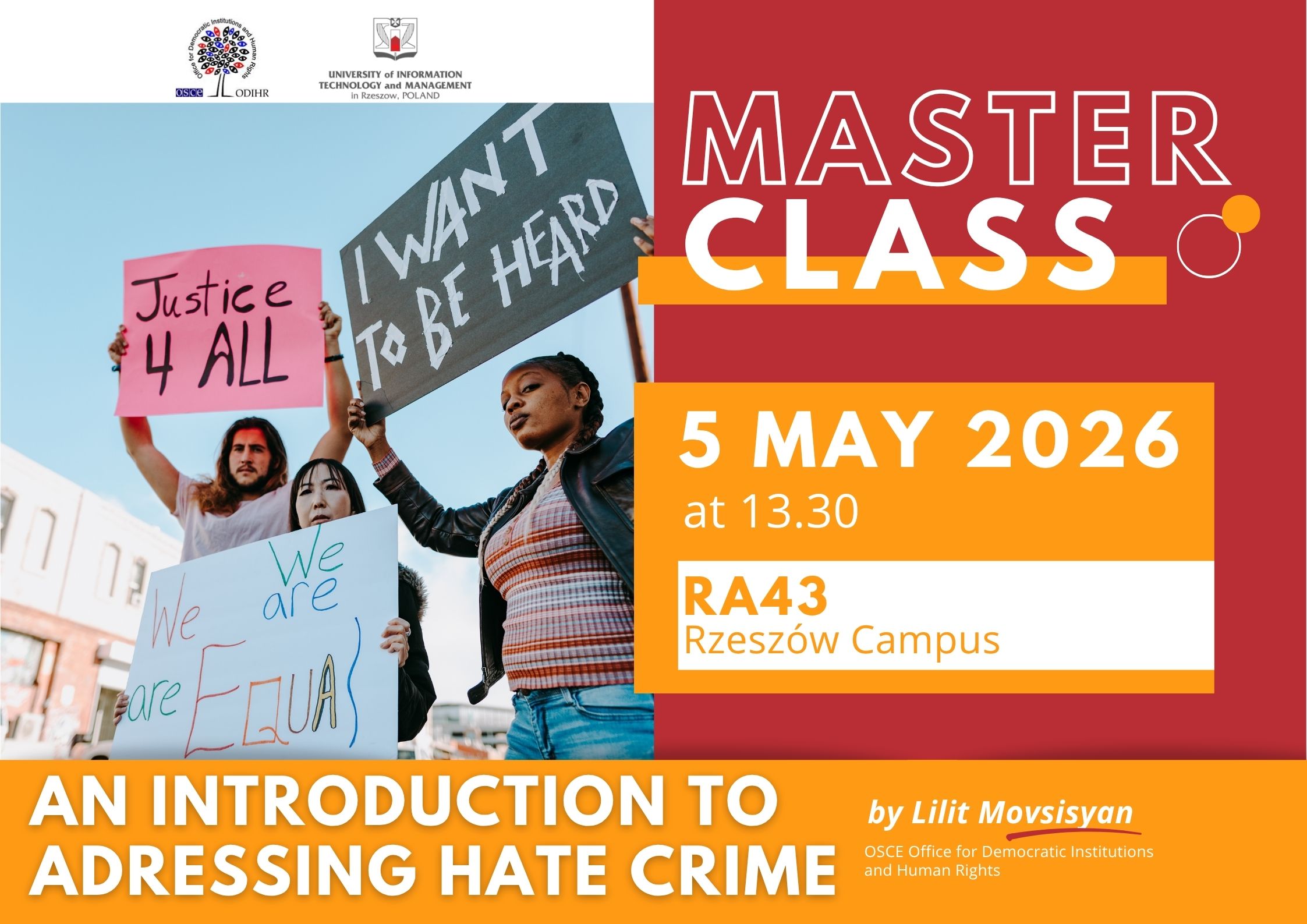
Addressing the complex dynamics of prejudice and systemic discrimination requires a structured, academic approach grounded in real-world expertise. Recently, the University of Information Technology and Management in Poland hosted a specialized workshop titled “Understanding Hate Crime & Unconscious Bias,” led by Lilit Movsisyan, a representative from the OSCE Office for Democratic Institutions and Human Rights (ODIHR) in Warsaw. This session provided a critical examination of how implicit biases form, how they escalate into tangible harms, and how future professionals can intervene effectively. For students and practitioners involved in social work education, these discussions are not merely academic—they represent the foundational knowledge required to protect vulnerable populations and build cohesive communities.
Integrating Hate Crime Prevention into Higher Education Curricula
Higher education institutions bear a significant responsibility in shaping the professional standards of the next generation. The decision by the University of Information Technology and Management to host an OSCE/ODIHR expert demonstrates a proactive commitment to integrating hate crime prevention directly into its academic framework. In an increasingly interconnected world, students must understand the mechanisms of intolerance to effectively counteract them in their future careers.
Workshops of this caliber bridge the gap between theoretical sociology and practical, on-the-ground application. By bringing in international experts like those from the OSCE, the university ensures that students are exposed to current, standardized frameworks used by global human rights organizations. This exposure is vital for students in Poland, a country that serves as a diverse crossroads within Europe, where understanding nuanced social dynamics is essential for community stability.
Schedule a free consultation to learn more about how academic programs integrate specialized human rights training into their curriculum.
Understand Unconscious Bias and Its Societal Impact
A central focus of the OSCE/ODIHR workshop was the concept of unconscious bias—the implicit attitudes or stereotypes that affect our understanding, actions, and decisions without our conscious awareness. Unlike overt prejudice, unconscious bias operates below the surface, making it particularly insidious and difficult to address. Individuals may genuinely believe they hold egalitarian views while simultaneously harboring biases that influence their behavior toward specific groups.
During the session, participants explored how these hidden biases manifest in everyday interactions, institutional policies, and broader societal structures. The experts emphasized that unconscious bias is a universal human cognitive shortcut. However, when left unexamined—especially by professionals in positions of authority such as law enforcement, educators, or social workers—these biases can lead to discriminatory practices that marginalize specific communities.
Recognizing unconscious bias is the first critical step in hate crime prevention. By learning to identify their own implicit prejudices, students can develop strategies to mitigate their impact, ensuring their professional judgments remain objective and fair.
Explore our related articles for further reading on the psychological foundations of bias and strategies for institutional change.
Legal Frameworks: Differentiating Attitudes from Criminal Behavior
A vital distinction clarified during the workshop was the legal boundary between personal attitudes and criminal behavior. In democratic societies, individuals possess the right to hold personal beliefs, even those that may be considered hateful or prejudiced. Thoughts and feelings, no matter how negative, are not criminalized. However, the legal threshold is crossed when those internal biases motivate harmful actions against others.
Acts such as assault, vandalism, threats, and stalking are classified as hate crimes when driven by “bias motivation.” This legal concept requires proving that the perpetrator targeted the victim because of a protected characteristic. As outlined during the OSCE/ODIHR presentation, these protected characteristics typically include disability, gender, religion, ethnicity, language, and nationality.
Understanding this legal distinction is paramount for professionals engaged in social work education. Social workers frequently interact with the legal system on behalf of their clients. They must possess the literacy to identify when an incident qualifies as a hate crime, as this classification directly impacts the legal protections, support services, and restitution available to the victim. Accurately navigating these legal frameworks ensures that victims receive appropriate justice and institutional support.
Prepare Future Professionals Through Targeted Social Work Education
The insights provided by the OSCE/ODIHR workshop hold specific, profound implications for social work education. Social workers are often the first point of contact for individuals and communities traumatized by hate crimes. Their role extends far beyond basic counseling; they must provide comprehensive support that addresses the legal, emotional, psychological, and social needs of the victim.
To prepare for this reality, social work students must be trained in trauma-informed care. A trauma-informed approach recognizes the widespread impact of trauma and integrates this knowledge into policies, procedures, and practices to avoid re-traumatizing the victim. When dealing with hate crimes, the trauma is often compounded by the targeted nature of the violence—an attack not just on the individual, but on their identity and community.
Furthermore, the workshop highlighted the necessity of inter-organizational collaboration. Social workers cannot operate in isolation. They must be adept at coordinating with law enforcement, legal advocates, psychological counselors, and specialized non-governmental organizations that focus on hate crime prevention and victim support. Effective social work education must therefore include training in multi-agency collaboration, teaching students how to build networks of care that provide holistic assistance to affected populations.
Submit your application today to join a program that prioritizes practical, real-world training in victim support and crisis intervention.
The Escalation Model: From Prejudice to Extreme Violence
One of the most compelling concepts discussed during the session was the escalation model of bias. The workshop illustrated that unchecked bias rarely remains static. What begins as a silent prejudice or unconscious stereotype can easily evolve into active discrimination, such as exclusion from services or employment. If left unchallenged, this discrimination can escalate into hate speech and, subsequently, violent hate crimes. In the most extreme historical cases, this unchecked escalation has culminated in genocide.
For students, understanding this continuum is a sobering but necessary lesson. It reinforces the idea that early intervention is not just beneficial, but essential. By addressing unconscious bias and prejudice at the earliest stages, social workers and community leaders can disrupt the escalation process before it results in physical or psychological harm. This proactive stance is a core tenet of modern hate crime prevention strategies.
Leverage E-Learning to Expand Human Rights Training
While in-person workshops led by international experts provide invaluable experiences, the principles they teach must be reinforced and distributed widely. This is where the integration of robust e-learning platforms becomes a critical asset for universities. The University of Information Technology and Management utilizes advanced e-learning infrastructure to ensure that vital training on topics like unconscious bias and hate crime prevention extends beyond a single seminar.
Through comprehensive e-learning modules, universities can standardize the delivery of complex human rights education. Digital platforms allow for the inclusion of interactive case studies, scenario-based learning, and self-assessment tools that help students continuously evaluate their own biases. Additionally, e-learning environments provide a safe space for students to engage with sensitive topics at their own pace, facilitating deeper reflection and understanding.
For international students, particularly those studying in Poland, e-learning also ensures accessibility. High-quality digital course materials break down language barriers and allow students to revisit challenging concepts as needed, ensuring that all graduates possess a uniform standard of competency in human rights and hate crime prevention.
Build Inclusive Communities Through Collective Action
Combating hate and fostering inclusivity is not the sole responsibility of social workers, law enforcement, or any single institution. As the OSCE/ODIHR representative emphasized, it requires a collective effort grounded in shared values, continuous education, and a firm commitment to human dignity. Educators, policymakers, healthcare providers, and private citizens all have a role to play in challenging harmful narratives and stereotypes.
Advocacy and community engagement are essential components of this collective action. Social workers and educated professionals must use their platforms to raise awareness about the realities of hate crimes and the subtle ways unconscious bias infiltrates daily life. By fostering open dialogues within communities, they can help dismantle prejudices before they take root.
The University of Information Technology and Management continues to demonstrate its dedication to these principles by hosting critical dialogues, investing in advanced e-learning tools, and preparing its students to be conscientious global citizens. By prioritizing hate crime prevention and comprehensive social work education, the institution contributes directly to the creation of safer, more resilient societies.
Have questions? Write to us! We can provide more details on how our curriculum prepares you for a career in human rights and social advocacy.
Share your experiences in the comments below regarding the importance of addressing unconscious bias in professional environments.